News
Laser Tube Cutting: Uses, Advantages, and the Bottom Line
Two square tubes need to meet at a right angle.
A connecting plate goes between them, with four bolts passing through. The tube-end angle is off by half a degree. A hole is misplaced by one millimeter. During installation, the result is not “slightly imperfect”—it simply does not fit.
The usual solution on site is to open up the hole with an angle grinder or enlarge the joint with a chisel.
The parts may eventually be assembled. But the ring around the hole is now exposed, the coating and oxide layer are gone, and water remains in the gap. Corrosion begins there.
This is a problem that should have been resolved before the parts reached the job site.
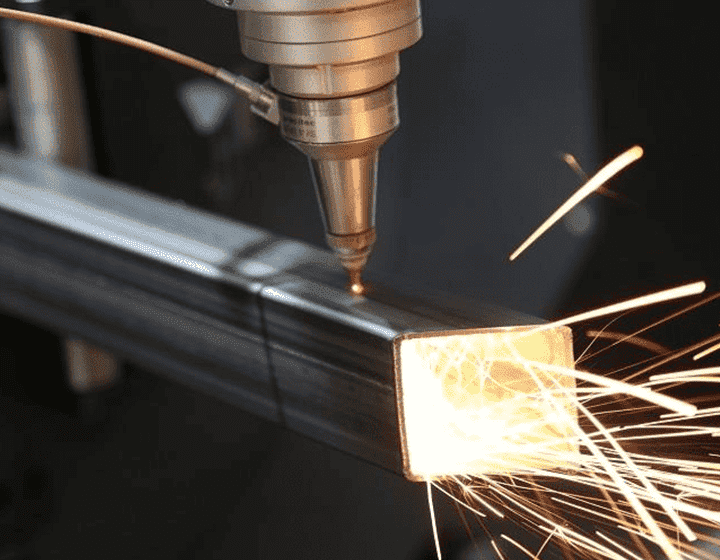
The tube is clamped in position, and the cut, holes, and end contour are completed in a single programmed process.

What Does Laser Tube Cutting Actually Cut?
Many people think laser tube cutting simply means “cutting a tube.”
Cutting the tube to length is the least valuable part. The real value of laser tube cutting lies in four operations:
Hole cutting. Round holes, oblong holes, square holes, and irregular holes can be produced in one pass, without a second setup.
Intersecting joints. The tube end can be cut into a saddle-shaped contour so that two tubes fit together for welding. This type of joint normally depends on manual layout, grinding, and trial fitting, which makes it difficult to produce consistently.
Angled and branch joints. The process can produce 45-degree miters, T-joints, angled tube ends, and weld-preparation bevels at the end of a tube.
Contour and slot cutting. Long slots, access openings, and shaped tube ends can be cut so that the tube itself becomes a structural component rather than a simple length of material.
These operations have one thing in common: the goal is not merely a flat cut face. The goal is accurate positioning.

The curved opening at the end of the round tube is cut as a joint contour, not ground into shape by hand.
The Advantage Is Not Simply Speed—it Is Getting the Parts to Fit
Traditional fabrication often uses separate operations: saw-cutting on a band saw, drilling on a drill press, and slotting on a milling machine, with a new fixture for each step.
Every new operation introduces another setup and another reference point. The errors accumulate.
A laser tube cutting machine combines the work in one programmed process and one setup. The tube end, hole positions, and other contours are calculated within the same coordinate system.
That is why the practical advantages include:
- Accurate cuts and better perpendicularity, producing smaller joint gaps and reducing welding and grinding.
- Clean cuts in stainless steel when nitrogen is used, with little or no need for additional deburring.
- No dedicated die for one-off or small-batch parts; a design change can be handled by changing the program.
- Nesting of long and short parts on one tube, which helps reduce short offcuts and material waste.

Holes, oblong slots, and an angled tube end are cut in one setup, keeping their relative positions consistent.
If the job only requires cutting tubes to length, these advantages may not justify the process. If it requires holes, complex contours, or repeatable joints, laser tube cutting becomes much more valuable.
How Should the Cost of Laser Tube Cutting Be Calculated?
The first reaction is often: “Is laser tube cutting expensive?”
That depends on how the job is measured.
If you compare only the price of cutting one meter of tube, a band saw may appear less expensive. But a single tube may also require more than 30 holes and two angled openings. Once sawing, drilling, deburring, marking, handling, and setup are included, the calculation changes.
There are two common ways to price tube laser cutting: by cutting length or by part. Parts with many holes and long contours may have a lower material cost per feature because the value is concentrated in the operations completed in one setup.
In simple terms:
The more holes, the more complex the shape, and the smaller the batch, the more worthwhile laser tube cutting becomes.
The Real Meaning: Move Error Correction Back from the Job Site to the Factory
This matters more than a small difference in cutting price.
A common traditional workflow is: fabricate first, then fit on site. The workshop cuts the tube slightly short, and the installation crew modifies it to fit in the field.
The error has not disappeared. It has only been pushed into the final operation, where installers use grinders, shims, and welding to solve it.
With laser tube cutting, the workflow changes. Dimensions on the drawing become the dimensions of the finished part. The relationship between parts is established in the workshop. The job site is responsible for assembly, not redesign.
For a designer, this means that complex joints, square layouts, oval forms, and dense hole patterns can be developed without shaping everything around the limitations of manual fitting.
For a fabricator, it means a broader processing range: one part can be completed without remaking a die when the design changes.
A large share of the money spent on a tube is usually not spent on the cut itself. It is spent on what happens during assembly afterward.

For a canopy or viewing platform, the parts fit together in the workshop so the site crew can focus on assembly.
Three Points to Check During Acceptance

Check the first part. After the first part is cut, use a tape measure and calipers to verify hole spacing and end angles against the drawing before continuing production.
Check the cut edge. Excessive yellow or black heat tint, heavy slag, or burrs may indicate incorrect parameters or impure assist gas.
Check the part marking. For multi-part and multi-size jobs, pack the tubes by drawing or part number so the installation team does not have to identify every tube at the job site.
These three checks keep laser tube cutting efficient instead of turning it into another source of rework.
Cut accurately, install cleanly—that is when the job is truly complete.
Top Stories
Product Categories
- Metal Laser Cutter
- Laser Welder Machine
- Laser Cleaner Machine
- Laser Marker Machine
- Press Brake Machine
Get Easy Solution