News
The Silent Dynamo: How a 500 watt Fiber Laser Cutting Machine Redefines Small-Scale Fabrication.
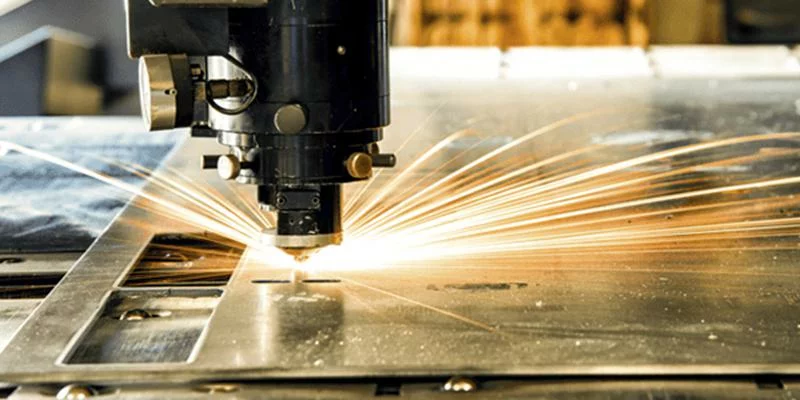
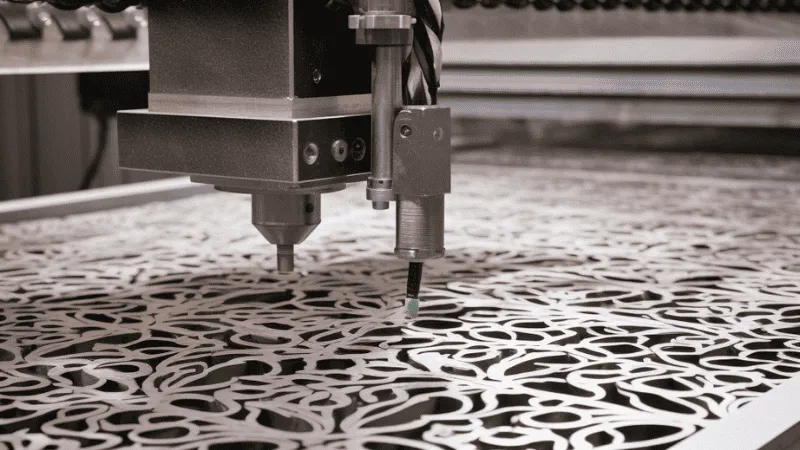
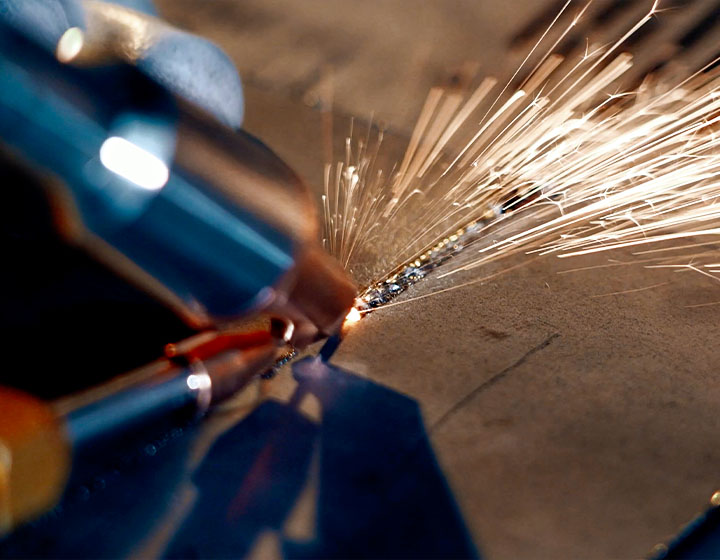
500 watt fiber laser cutting machine units are the unsung heroes of precision manufacturing, quietly revolutionizing workshops, startups, and specialized industries. Imagine crafting intricate jewelry components from gold or silver, etching permanent serial numbers onto surgical instruments with flawless clarity, or rapidly producing hundreds of precise electronic enclosures from thin stainless steel – all with minimal heat distortion and zero tool wear. This compact powerhouse leverages the core principles of fiber laser technology but operates at an accessible power level, making high-precision laser cutting metal achievable without the footprint or price tag of industrial giants. Its agility shines in processing thin gauges and delicate materials where brute force is counterproductive.
Where the 500 watt Excels: Niche Domination:
Don’t underestimate the capabilities packed into a 500 watt fiber laser cutting machine. Its strengths are perfectly aligned with specific, high-value applications:
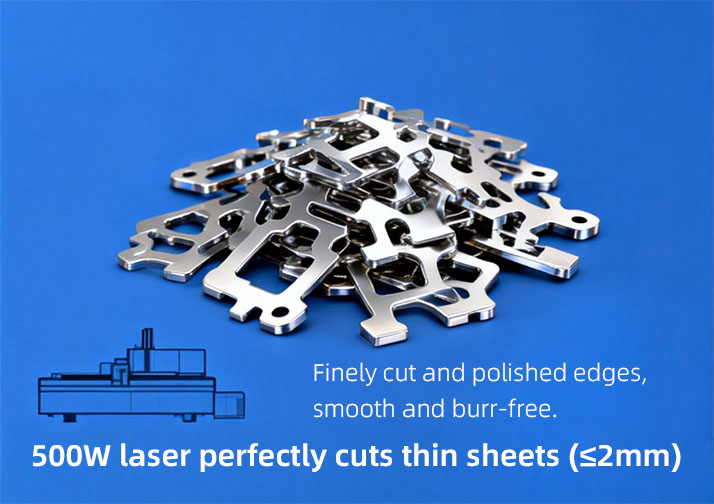
- Ultra-Thin Sheet Metal:This is its sweet spot. Expect clean, high-speed cuts on mild steel up to 2mm (14ga), stainless steel up to 1.5mm (16ga), and aluminum up to 2mm. Ideal for electronic chassis, brackets, shims, clips, and decorative overlays.
- Precision Etching & Marking:Beyond cutting, the fiber laser beam excels at surface marking. A 500 watt fiber laser can engrave logos, barcodes, serial numbers, and data matrix codes onto metals (steel, aluminum, titanium, brass), plastics, and even ceramics with exceptional permanence and detail, replacing traditional engraving methods.
- Non-Metal Processing:While optimized for metal, the focused beam can effectively cut and engrave many plastics (acrylic, polycarbonate, ABS), woods, fabrics, leather, and paperboard with precision unmatched by CO2 lasers on reflective metals.
- Jewelry & Precision Engineering:The ability to cut intricate shapes from precious metals (gold, silver, platinum) and tough alloys used in watchmaking or medical devices without burrs or distortion is invaluable. Minimal kerf width preserves precious material.
- Prototyping & R&D:Rapid iteration of complex thin-gauge parts becomes cost-effective and fast, accelerating product development cycles without requiring large production machinery.
- Educational & Maker Spaces:Its relatively lower cost, smaller size, and reduced safety infrastructure requirements (compared to higher-power lasers) make it a feasible entry point for technical schools and advanced maker labs.
Key Advantages Over Alternatives:
Choosing a 500 watt fiber laser cutting machine offers distinct benefits:
- Lower Acquisition & Operating Cost:Significantly cheaper to purchase and run than higher-power fiber or CO2 lasers. Electricity consumption is modest.
- Compact Footprint:Fits easily into smaller workshops or benchtop configurations, maximizing floor space.
- Exceptional Precision & Edge Quality:On thin materials, it produces near-mirror finishes with minimal HAZ. Kerf widths can be extremely narrow (<0.1mm).
- Speed on Thin Gauges:For materials within its optimal range, cutting speeds can be remarkably high (e.g., >20 m/min on 1mm mild steel with air or oxygen), boosting productivity for high-volume small parts.
- Minimal Maintenance:Fiber laser sources are solid-state and robust. Consumables (lenses, nozzles) are small and relatively inexpensive.
- Ease of Use:Modern systems feature intuitive software, simplifying operation for non-specialists after basic training.
Critical Considerations & Limitations:
Understanding the boundaries of a 500 watt fiber laser cutting machine is crucial for realistic expectations:
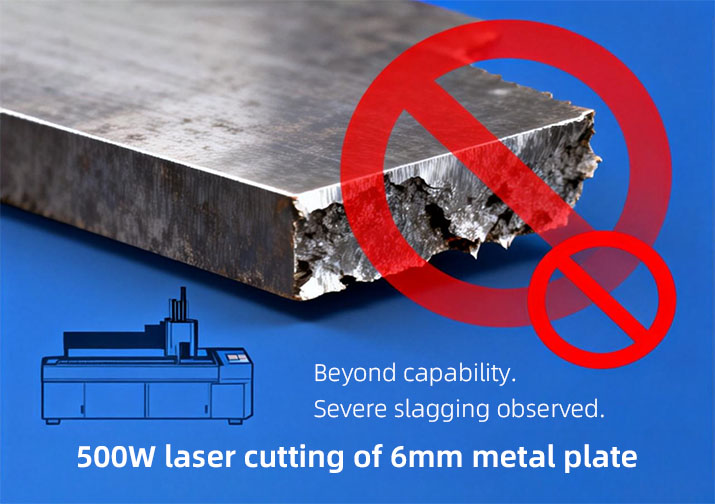
- Thickness Limitations:It is not designed for plate cutting. Attempting materials beyond its capacity (e.g., >3mm mild steel) results in poor cut quality, excessive dross, slow speeds, and potential damage to the machine.
- Reflective Material Challenges:While fiber lasers handle reflectivity better than CO2, cutting highly reflective metals like copper or brass with a 500 watt laser requires careful parameter tuning, high-pressure assist gas (often nitrogen), and is generally limited to very thin sheets (<1mm).
- Assist Gas Requirements:While air can sometimes be used for thin mild steel etching or cutting non-metals, achieving clean cuts on stainless or aluminum typically demands bottled nitrogen, adding operational cost. Oxygen is used for faster mild steel cutting but creates oxidation.
- Cutting Head Technology:The quality of the cutting head (collimator, focus lens, nozzle design) significantly impacts performance, especially on the edge quality of thin, reflective materials.
Maximizing Your 500 watt Investment:
To get the most from a 500 watt fiber laser cutting machine:
- Focus on Its Strengths:Prioritize jobs within its core competency: thin metal cutting, engraving, marking, and non-metal fabrication.
- Master Nesting:Efficiently packing parts onto sheets is paramount for material cost savings, especially with expensive metals. Use advanced nesting software features.
- Optimize Parameters:Invest time in developing and saving optimized cutting recipes for each material type and thickness. Small adjustments in speed, power, frequency, gas pressure, and focal position make big differences.
- Prioritize Maintenance:Keep lenses and nozzles impeccably clean. Regularly check optical paths and alignment. Follow the manufacturer’s maintenance schedule rigorously to prevent costly downtime.
- Invest in Training:Ensure operators understand not just how to run the machine, but the physics behind the process to effectively troubleshoot and optimize.
The Gateway to Laser Technology:
A 500 watt fiber laser cutting machine is more than just a tool; it’s an accessible portal into the world of advanced digital fabrication. It empowers small businesses, artisans, and innovators to produce work with a level of precision and professionalism previously out of reach. By understanding its capabilities and limitations, users unlock a versatile platform for creating high-value components, intricate designs, and durable markings, proving that immense capability can indeed come in compact, efficient packages. It democratizes precision, one focused beam at a time.

Top Stories
Product Categories
- Metal Laser Cutter
- Laser Welder Machine
- Laser Cleaner Machine
- Laser Marker Machine
- Press Brake Machine